
Padel
Court: 20 × 10 m, enclosed by glass walls and metal mesh.
Play: almost always doubles; the ball stays in play off the walls.
Serve: underhand, after a bounce, hit at or below the waist.
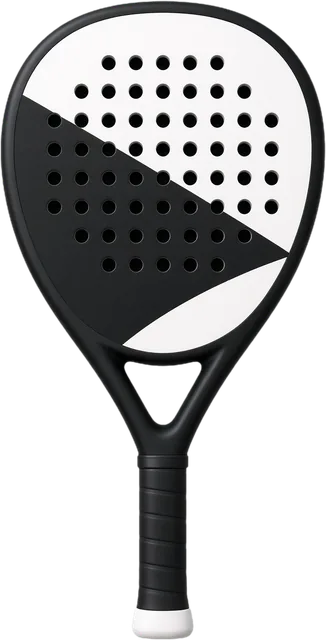
Racket: solid and perforated, no strings, at most 45.5 cm long.
Tennis
Court: 23.77 m long, 10.97 m wide for doubles (8.23 m for singles), no walls.
Play: singles or doubles.
Serve: usually overhead, hit before the ball touches the ground.
Racket: strung, up to 73.7 cm long.
The court and the walls
A padel court is 20 m long and 10 m wide, a little shorter than a tennis court and closed in by walls: glass at the back and in the corners, mesh along the sides. After the ball bounces on your side it can hit the glass and stay in play, so you can let it come off the wall and still return it. A tennis court is 23.77 m long with open space behind the baseline, and the point ends once the ball bounces twice.
The serve
This is the first thing tennis players notice. In padel you bounce the ball and hit it underhand, at or below waist height, diagonally into the service box. You can't win many points with the serve, so rallies start more evenly. In tennis the server hits the ball before it touches the ground, usually overhead, and the serve is often a weapon.
Racket and ball
A padel racket has no strings: it's a foam or EVA core inside a perforated face, at most 45.5 cm long, with a wrist cord. It's shorter and more solid than a tennis racket (up to 73.7 cm), so the swing is compact and most shots are played in front of the body. The padel ball looks like a tennis ball but has slightly less pressure, which keeps rallies at a speed the small court can handle.
Scoring
Padel uses tennis scoring: 15, 30, 40, game, sets to six, and tie-breaks. Many padel events play a "golden point" at deuce: one deciding point instead of advantage. Tennis has a similar no-ad option, but most tennis matches still use advantage.
How tennis players adapt
- Shorten the swing. Big tennis backswings hit the glass or the side mesh. Compact strokes and volleys work better.
- Let the ball come off the glass. The hardest habit to learn: wait for the ball after it bounces off the back wall instead of rushing it.
- Hit lobs and get to the net. In padel the team at the net usually wins the point, and the lob is how you take the net back.
- Don't buy a power racket yet. Even good tennis players start best with a round, forgiving padel racket while they learn the walls.
Which is easier to learn?
For most beginners, padel. The underhand serve, the smaller court and the walls keep the ball in play, so new players have real rallies in their first hour. Tennis takes longer before games feel fun, but it rewards practice with a bigger, faster game. Many people play both.
Sources: ITF Rules of Tennis 2026 (court, net, racket, serve, scoring), summary of the FIP padel rules (court, racket, serve), Padel (Wikipedia). Checked 29 October 2026.